Ужасающие рассказы о пытках до смерти в тюрьмах Джолани — Расследование Reuters
Harrowing accounts of torture to death in Jolani's prisons — one detainee was slaughtered by having his throat cut.
Excerpted from a Reuters investigation:
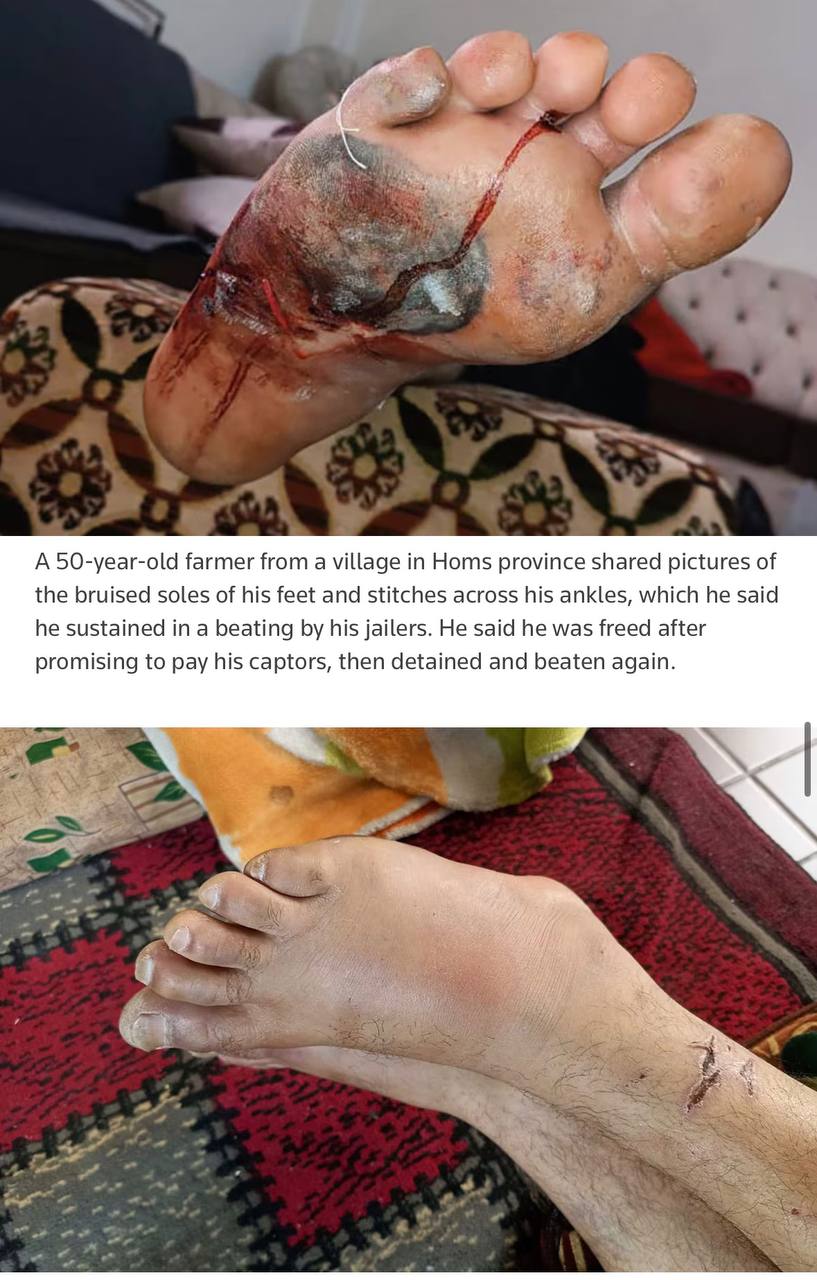
There is "the tire," a torture method involving a rubber tire frame, which the farmer was subjected to. "The shabh" is the practice of hanging the victim by their wrists. "Welcome parties" take place upon arrival, where jailers line both sides of a corridor and shower new detainees with beatings.
A young Alawite man said he was arrested on March 9 in Latakia after leaving his home during a government security crackdown in response to a pro-Assad uprising. He said men in black clothes pulled his jacket over his head, removed his shoes, and pushed him into their vehicle on suspicion that he had been filming the movements of security forces with his phone.
The young Alawite man said the abuse began immediately with a "welcome party" at the Military Security branch in the coastal region.
"Everyone ordered me to bark like a dog. They beat me with rifle butts, their hands, and their shoes. I thought my life was about to end," he said.
From there, he said he was transferred to three other detention centers in Latakia, all in use since the Assad era, each with its own welcome party. He added that he was hung by his ankles, with a gun placed in his mouth. He was also placed alone in a windowless room for 20 days.
He said that during two transfers, his jailers spoke of killing him and throwing his body into the sea because the detention facilities had become overcrowded.
Finally, after four months, he was released still barefoot. The shoes taken from him at the time of his arrest were never returned.
Reuters was unable to independently verify the young man's account, but it was consistent with the type of violations described by at least eight other former detainees, who had witnessed or experienced them personally. He was also among at least 53 detainees whose cases exceeded the legal limit of 60 days during which a person can be held without judicial proceedings.
Reuters documented at least 11 people who died in detention by speaking to their relatives, including three whose deaths the government said are under investigation. The government did not provide a total number of deaths in custody, and did not comment on the findings related to them.
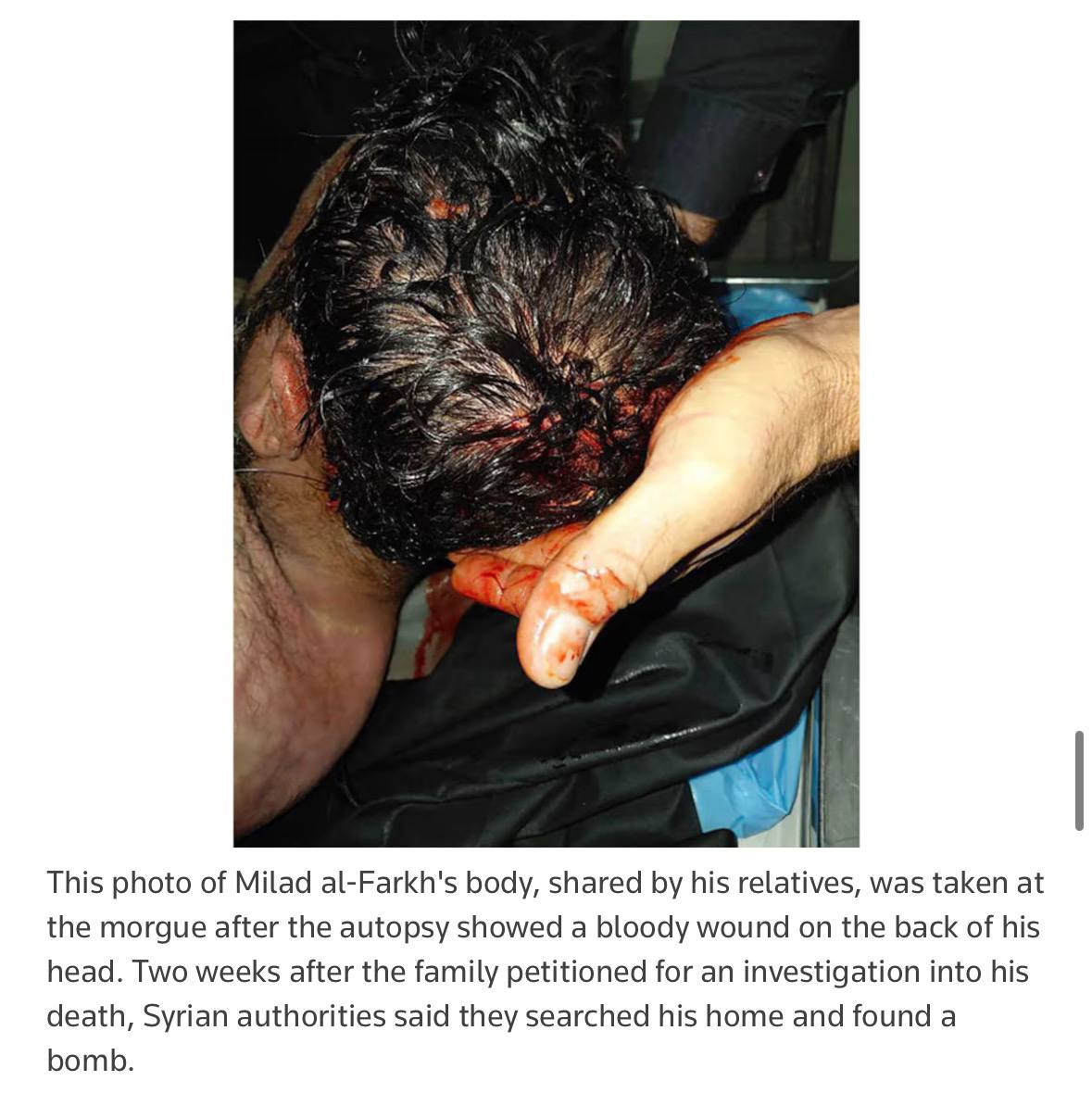
Among those who died was a detainee in Kafr Sousa — a 59-year-old Christian merchant named Milad al-Farakh. His family said he was arrested on August 24 on charges of concealing weapons, working as an arms dealer, and selling expired meat at the butcher shop he owned.
Family members described the arrest as an attempt to pressure them into paying $10,000 in protection money.
Two weeks later, a fellow prisoner in Kafr Sousa managed to make a phone call to the family to tell them that al-Farakh was on the verge of death as a result of torture. The following day, September 9, a call came from the hospital morgue, according to the family.
A relative was arrested for demanding an autopsy. In the end, after the intervention of a senior internal security official and religious figures, doctors concluded that al-Farakh died as a result of his head striking something in a fall. The body was handed over to the family. To this day, the family has not seen the autopsy report or any written record of his arrest or death.
Reuters reviewed photographs of al-Farakh's body taken at the morgue, which showed what appeared to be a bloody wound to the back of his head.
On September 25, after the family submitted a request to investigate al-Farakh's death, the Ministry of Interior announced that it had searched his home and found a bomb. The family denies the presence of any explosives in the home.
Reuters also documented deaths at a checkpoint in Tartous and in the prison there, as well as in other detention facilities, including a police station in Damascus near the famous Umayyad Mosque.
Three families said they only learned of their relatives' deaths after their bodies had already been buried. Among them were three men arrested in Homs in January — a veteran soldier and his two sons, who were also soldiers under Assad. The family said they were last seen being led away by internal security personnel.
The governor's office informed them that the men were in the central prison in Homs. Over five months, they said they regularly visited the prison to leave food, medicine, and clean clothes, and to collect dirty clothes they were told belonged to the three men. They also paid thousands of dollars to unknown intermediaries, but were never allowed to see the men.
"The regime fell, but those who rule today decided to turn Assad's prisons into new prisons… It is the most absurd thing I have ever seen in my life."
Finally, two relatives went to the morgue out of desperation and convinced an employee to check digital photographs of unidentified bodies. There the family discovered that the men had been dead since January.
Two family members said the autopsy notes written beneath the photographs indicated that the father, aged 62, had been slaughtered — his throat cut. They added that one son's face was disfigured and the skin had been stripped from his body, while the other was killed by a gunshot to the face.
Source: Reuters investigation into detention and torture in Syria, 2025.
Свидетельство
Расследование Reuters — Содержание под стражей и пытки в Сирии, 2025