Documenting the Black March 2025 Massacres Against the Alawites
Memorializing the Massacres
of the Coast
Documenting the victims and massacres of Black March 2025 in the coastal region. Honoring the martyrs and documenting the truth.
26,000+
Refugees in Lebanon from Black March Massacres
Affected Areas
Massacre Areas
Tartous
Baniyas
March 7-9, 2025
Between March 7 and 9, 2025, armed groups swept through Baniyas — a port city on the Mediterranean coast — in …
View memory →
Tartous
Khirbet al-Qabu
March 2025
As HTS factions swept through the Baniyas countryside in March 2025, the small Alawite village of Khirbet al-Q…
View memory →
Lattakia
Jableh
March 6-11, 2025
From March 6 to 11, 2025, Jableh and its surrounding countryside were subjected to a sustained campaign of kil…
View memory →
Lattakia
Al-Mukhtariya
March 7, 2025
On March 7, 2025, extremist factions operating under the new military leadership descended on Al-Mukhtariya an…
View memory →
Jableh
Sonobar
March 2025
Sonobar — named for the pine forests covering its hills — sits in the Jableh countryside. Stone houses, agricu…
View memory →
Lattakia
Qardaha
March 2025
Qardaha sits high in the Lattakia mountains, and for centuries that elevation had offered its communities some…
View memory →
Lattakia
Al-Dautor
March 6-10, 2025
On March 7, armed groups raided the Al-Dautor neighbourhood of Lattakia city, killing 65 civilians and leaving…
View memory →
Lattakia
Al-Haffa
March 2025
What the video evidence from Al-Haffa captured is not the chaos of combat. It is the cold geometry of a mass e…
View memory →
Lattakia
Qarfis
March 6-11, 2025
Between March 6 and 11, 2025, the village of Qarfis in the Lattakia countryside was subjected to a five-day as…
View memory →
Lattakia
Shalfatiya
March 8, 2025
On March 8, 2025, Al-Shalfatiya in the Lattakia countryside became the site of a massacre documented in part t…
View memory →
Lattakia
Brabshbo
March 2025
Brabshbo is a farming village in the Lattakia countryside, a community whose life was built around its olive g…
View memory →
Lattakia
Shrifa
March 7, 2025
The massacre in Shrifa on March 7, 2025, did not arrive without warning. In the weeks before, religious platfo…
View memory →
Lattakia
Daliya
March 6, 2025
The events in Daliya show how a minor local incident was transformed — deliberately — into a pretext for overw…
View memory →
Hama
Al-Rasafa
March 7, 2025
The attack on Al-Rasafa on March 7, 2025, is among the most thoroughly documented atrocities of the coastal ca…
View memory →
Tartous
Al-Hattaniya
March 9, 2025
On the evening of March 9, 2025, residents of Al-Hattaniya heard the armed groups advancing and made the only …
View memory →
Tartous
Al-Maydan
March 2025
The attack on Al-Maydan began with artillery bombardment — a show of force intended to terrorise and disorient…
View memory →
Tartous
Hreisoun
March 10, 2025
On March 10, 2025, forces affiliated with the Jolani regime stormed Hreisoun, a small Alawite village in the B…
View memory →
Hama
Al-Alamein
March 2025
A massacre unfolded over two consecutive days in the village of Al-Alamein in the southern Hama countryside, n…
View memory →
Jableh
Bustan al-Basha
March 2025
Reports confirmed that HTS militants took victims from the area of Bustan al-Basha and buried them — not buria…
View memory →
Hama
Al-Bustan
March 2025
The village of Al-Bustan lies in the Masyaf countryside of Hama, well inland from the coast that drew most int…
View memory →
Homs
Batisa
March 2025
After midnight, when the village of Batisa in the western Homs countryside was asleep, gangs operating under t…
View memory →
Hama
Aseila
March 2025
In the village of Aseila in the Hama countryside, an unarmed Alawite civilian man was summarily executed. He c…
View memory →
Hama
Al-Tuweim
March 2025
The Hayat Tahrir al-Sham organisation carried out a massacre in Al-Tuweim, a village in the western Hama count…
View memory →
Hama
Salhab
March 7, 2025
On March 7, 2025, armed factions entered Salhab in the western Hama countryside as part of the broader offensi…
View memory →
Tartous
Barmaya
March 2025
In Barmaya, a village in the Tartous countryside, HTS militants killed unarmed Alawite civilians. What followe…
View memory →
Jableh
Rmeila
March 2025
A video emerges from Rmeila, a village in the Jableh countryside. The man holding the camera is walking. His v…
View memory →
Tartous
Al-Qadmus
March 2025
Armed factions entered Al-Qadmus as part of the coordinated offensive that swept through Tartous governorate i…
View memory →
Tartous
Hammam Wasel
March 9, 2025
On March 9, 2025, military groups raided Hammam Wasel, a village known for its natural setting in the Tartous …
View memory →
Documentation
Reports & Documentation
2026-04-03T14:39
اختطاف نساء وفتيات من الأقلية العلوية في سوريا أكثر شيوعاً وأشد وحشية مما اعترفت به الحكومة
<img src="https://res.cloudinary.com/dsoy0tqjp/image/upload/v1775212302/syria-memorial/sfoltqttweuuhxk6p7ln.webp"><p><br>A 16-year-old girl left her home in northwest Syria last May to visit a shop and disappeared. Weeks later, an anonymous stranger phoned her distraught family and said that he had the teenager and would let her go if they paid thousands of dollars in ransom, according to four people involved in her case.</p><p>The family paid the ransom and the girl returned in August, more than 100 days after she had been kidnapped. She told confidants that she had been held in a dank basement and was regularly drugged and raped by strangers, the four people said.</p><p>A medical exam turned up yet another shock: She came home pregnant.</p><p>Since rebels ousted the dictator <strong>B al-A</strong> in late 2024, panicked families and activists trying to help have regularly sounded the alarm on social media that women and girls from Syria's <strong><u>Alawite</u></strong> minority have mysteriously disappeared or been kidnapped. Many fear that their sect is being targeted as retribution for the brutality of <strong>Mr. al-A</strong>, who also belongs to the <strong><u>Alawite</u></strong> sect, an offshoot of Shiite Islam.</p><p>The government has denied that <strong><u>Alawite</u></strong> women and girls are being targeted by kidnappers, saying that it has confirmed only one such case. But a New York Times investigation based on dozens of interviews with Alawites who say they were kidnapped, their relatives and others involved in their cases found that these abductions have been common and often brutal.</p><p>The Times verified the kidnappings of 13 <strong><u>Alawite</u></strong> women and girls, in addition to one man and one boy. Five said they had been raped. Two came home pregnant.</p><p>The family of one woman said it sent $17,000 to kidnappers who never released her, and provided screenshots of ransom demands and the money transfers. A 24-year-old said she had been held for three weeks in a filthy room where men raped her, beat her, shaved her head and eyebrows and cut her with razor blades. Her relatives also paid the kidnappers and in this case secured her release, according to four people involved in her case.</p><p>Syrian activists say they know of scores of such kidnappings but details are difficult to confirm because victims and their families are too scared to talk.</p><p>Most people who spoke with the Times did so on condition of anonymity for fear of reprisals from the government or the kidnappers. The Times is not identifying most of those who were kidnapped for the same reason.</p><p>The Times corroborated accounts from people who had been kidnapped and their relatives, as well as through social media posts announcing when they were taken and returned, ransom messages sent by kidnappers and interviews with medical and aid workers who spoke with the abductees after their release.</p><p>The kidnappings took place against a backdrop of deep distrust between the <strong><u>Alawites</u></strong>, who make up about one-tenth of Syria's population, and the new government. <strong>Mr. al-A</strong> relied heavily on his sect in his military and security services while in power.</p><p>Jableh countryside, northwest Syria, site of some of the sectarian violence that killed about 1,400 people, most of them <strong><u>Alawite</u></strong> civilians.</p><p>That led many of the Sunni Muslim former rebels who now run Syria to associate the <strong><u>Alawites</u></strong> with the ousted regime.</p><p>Last March, that anger fueled days of sectarian violence in northwestern Syria that left about 1,400 people dead, according to a U.N. investigation. The inquiry found that some government security forces had participated in the killing, leaving many <strong><u>Alawites</u></strong> afraid of them.</p><p>Many of the kidnapped women and girls, along with their relatives, said the government had failed to take their cases seriously.</p><p><strong>N al-D B</strong>, the Interior Ministry spokesman, said in an interview that he could not respond to The Times' findings unless it provided the names for the cases it had verified, which The Times declined to do. He said that pregnancies did not prove kidnappings and that ransom messages could be fabricated.</p><p>"For all of those ransoms, where is the proof?" he said.</p><p>He added that he stood by a government investigation released in November that examined 42 reported kidnappings and found that only one of them was "real."</p><p>In the other cases, he said, the women were involved in prostitution or other crimes, ran away with lovers or fled domestic troubles. They and their families, he said, then claimed they had been kidnapped to avoid social stigma.</p><p>The kidnap victims and their relatives painted a very different picture, one of women and girls grabbed off the street by armed men near their homes or while running errands.</p><p>They reported being taken by fellow Syrians or by foreign jihadists who had come to Syria during the country's 13-year civil war, hoping to establish an Islamic state. Many women and girls reported that their captors had insulted <strong><u>Alawites</u></strong>, saying they deemed them permissible to rob and rape — a view propagated by Islamist extremists.</p><p>One 33-year-old was kidnapped by four armed men last summer, according to the woman and two others involved in her case said. Like other abductees, she recalled her captors asking whether she was <strong><u>Alawite</u></strong>. She said yes and they replied that they were "'going to have a good time,'" she recalled.</p><p>"They wanted to humiliate the <strong><u>Alawites</u></strong>," she said.</p><p>"They wanted to humiliate the <strong><u>Alawites</u></strong>," a woman who said she was kidnapped last summer recalled.</p><p><strong>R F</strong>, the executive director of the Syrian Feminist Lobby, a nonprofit organization that has tracked kidnapping cases, said sectarian revenge drove the abductions.</p><p>"It is systematic and it is targeting this community," she said. "They are trying to make the community vulnerable."</p><p>The Times also documented five cases of <strong><u>Alawite</u></strong> women who had disappeared and remain missing, although it was not possible to determine whether they had been abducted.</p><p>One of them, <strong>E J</strong>, 41, disappeared in May after buying ice cream near Syria's Mediterranean coast, according to her mother, <strong>R S</strong>. The family had reported her disappearance to the police but had received no updates and have not been contacted by any kidnappers.</p><p>The spot where <strong>E J</strong>, 41, disappeared in May after buying ice cream.</p><p><strong>E J's</strong> mother, <strong>R S</strong>.</p><p><strong>Ms. S</strong> showing pictures of her missing daughter.</p><p>The Times could not independently confirm all the details of the cases. But they overlapped with or bore striking similarities to others documented by rights groups. Amnesty International said in July that it had credible reports of 36 similar kidnappings and had documented eight cases.</p><p>In August, a U.N. commission said it had documented six such cases and received "credible reports" of dozens more that it was still investigating.</p><p>The Syrian Feminist Lobby has counted 80 <strong><u>Alawite</u></strong> women and girls who have disappeared since early 2025, <strong>Ms. F</strong> said. Twenty-six of the cases were confirmed kidnappings, including of women who suffered physical or psychological abuse, she said.</p><p>Ten have returned home, three are still missing and the status of the other 13 remains unclear, she said, adding that the government had not supported those who had returned.</p><p>"They are more shaming the women than seeing them as survivors," she said.</p><p>All of the families that spoke to The Times said they had reported their cases to the security forces. While some dealt with sympathetic officers, many said the security personnel had been dismissive or accused the missing women and girls, without evidence, of using drugs or running away with their boyfriends.</p><p>Some security officers told the families of those who had returned to lie about what had happened.</p><p><strong>W I</strong>, 24, said she was abducted near the university where she was studying in the central city of Homs in May. Her captors demanded a ransom of $15,000 but let her go after activists spread news of her disappearance online and her widowed mother told her captors that she could not pay.</p><p><strong>W I</strong>, 24, in her family's orchard in northwest Syria.</p><p><strong>Ms. I</strong> described her kidnappers as criminals motivated by money, not sectarianism. After she returned, she said, security officers told her family to say that she had been visiting a friend.</p><p>"I said no," her mother, <strong>I S</strong>, recalled. "I put out a video to tell everyone what happened."</p><p>In an interview, a police investigator who spoke on condition of anonymity because he was not authorized to talk to journalists, said he had worked on 10 reported kidnappings and that nine of them had been "fake." One was real, and the woman had come home pregnant.</p><p>"It destroyed her life," he said.</p><p>Many of the women and girls who have returned said they suffer from trauma that has disrupted their educations, careers and sleep. Some have separated from their husbands and a few have fled Syria, fearing their kidnappers could come for them again.</p><p>One 19-year-old was held for a few days last summer by a foreign jihadist, she and three others with knowledge of her case said. Since then, she said, she had been depressed, lost her love of sports and abandoned her plans to go to university.</p><p>"I used to go out with my friends, but now I don't want to leave the room," she said. "I'm scared of the people around me."</p><p>A 19-year-old who said she had been depressed, lost her love of sports and abandoned her plans to go to university after she was held for a few days last summer by a foreign jihadist.</p><p>The pregnant 16-year-old told confidants that her captors had given her sleeping pills and allowed strangers to rape her. She was released for a ransom of about $2,500 and returned to her family, poor farm laborers.</p><p>Abortion is illegal in Syria, even in cases of rape. She wanted to keep the baby anyway.</p><p>"It is my child," she said. "What did it do wrong?"</p><p>In February, she gave birth to a healthy baby girl.</p><p><strong>B H</strong> is the Istanbul bureau chief, covering Turkey and the surrounding region.</p>
2026-04-03T14:39
Source: The New York Times
2026-03-16T18:13
The Jolani Regime's Media Is Working Overtime to Deny the Alawite Massacres
On the anniversary of the coastal massacres, a media figure tied to the Jolani terrorist regime named Musa al-Omar claimed that a photograph of Alawite families killed in #Baniyas was fake, saying it was actually a picture of a Russian family sleeping. It isn't.  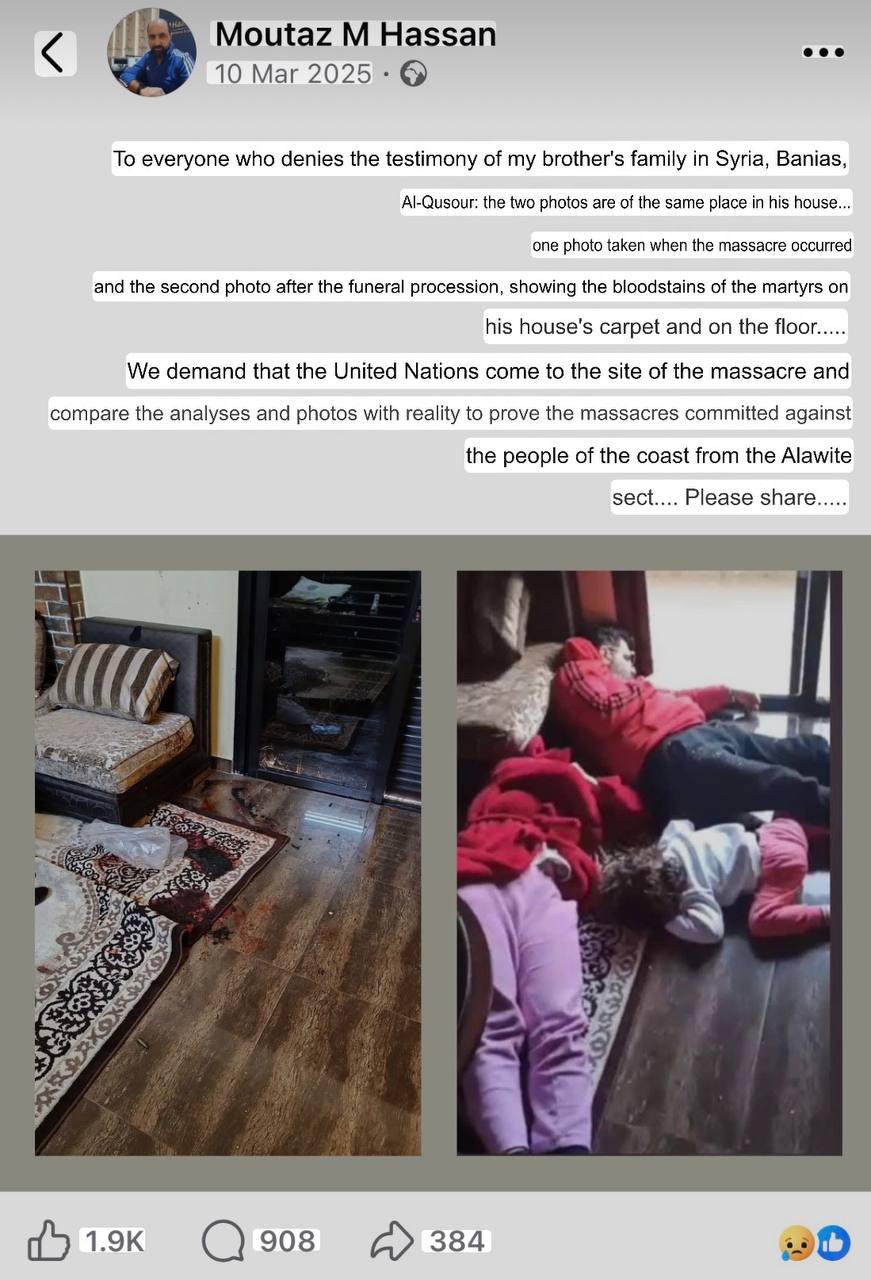 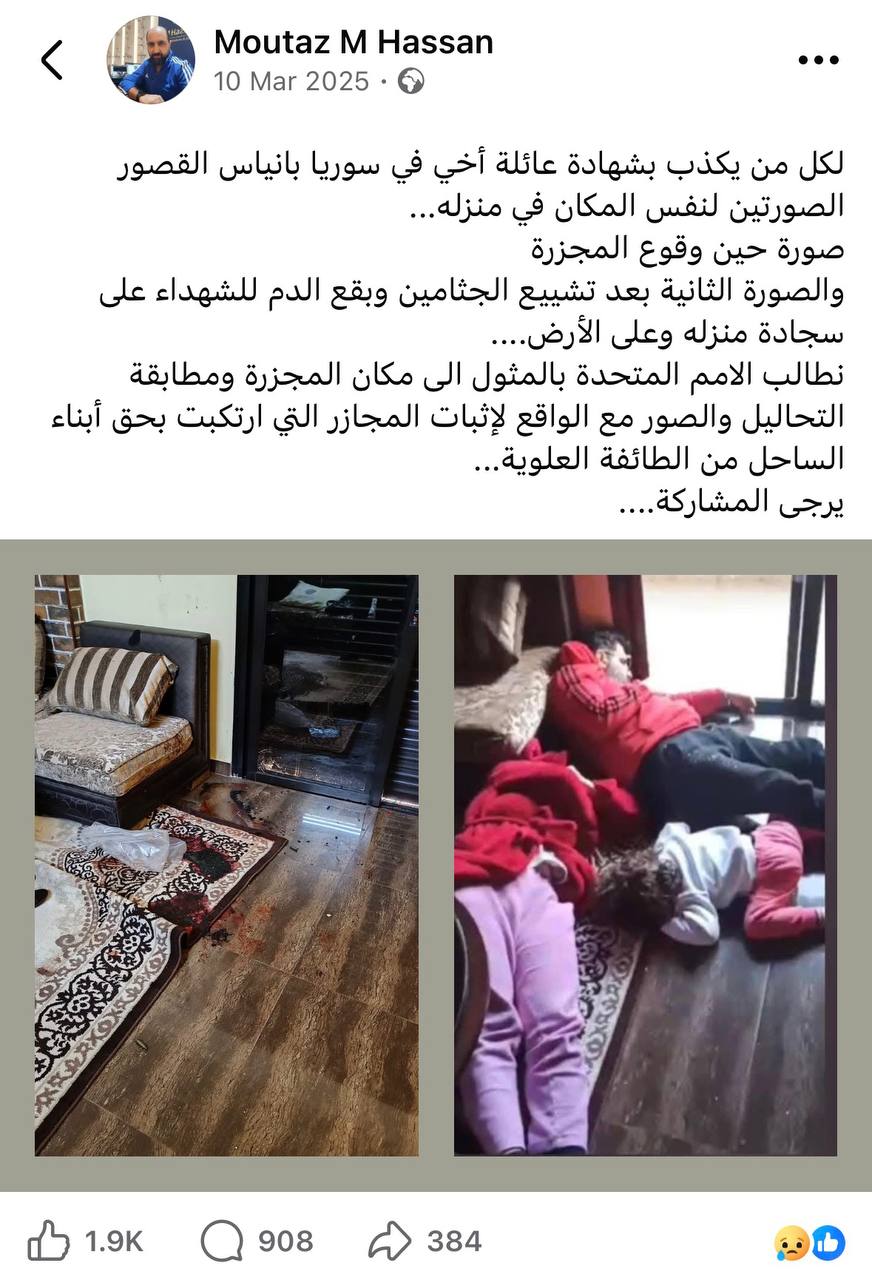 The people in that photograph are real victims: Muhannad Hassan, a math teacher; his wife, Lina Abdullah; and their baby daughter, Manisa Hassan, born in 2021. They were killed in the al-Qusour neighborhood of Baniyas on March 8, 2025. Muhannad's mother was also killed that day, and her body was in another room. When Muhannad's brother, Moutaz Hassan, found out his family's image was being used to spread this lie, he posted a follow-up photo taken after the bodies were removed, bloodstains visible on the floor of the same room, and demanded a UN investigation. 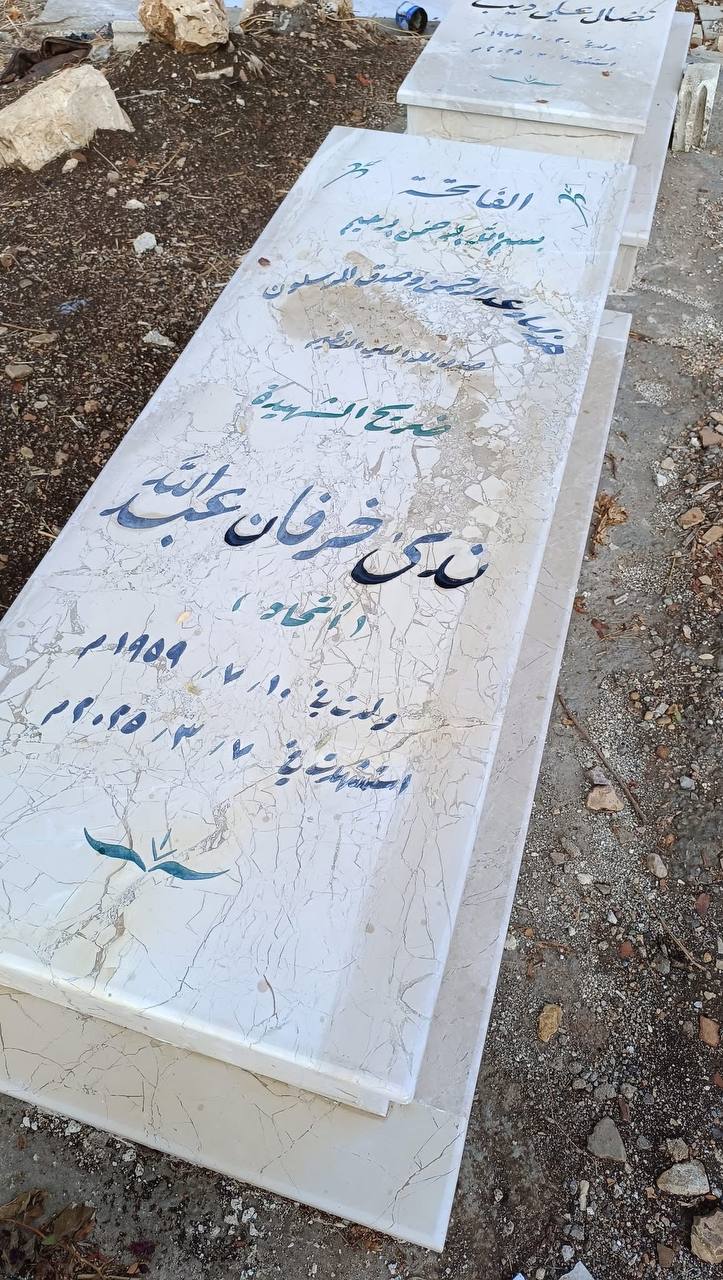 This isn't a mistake or a misunderstanding. This same photo was used in a coordinated disinformation campaign last year. Multiple fact-checking outlets, including "Ta'akad= Verify," verified that the image is genuine and shows an Alawite family from the Baniyas massacres. And yet the denial campaign keeps going. It even involves exaggerating the killing of security forces on March 6 to retroactively justify the slaughter of thousands of innocent Alawite civilians. 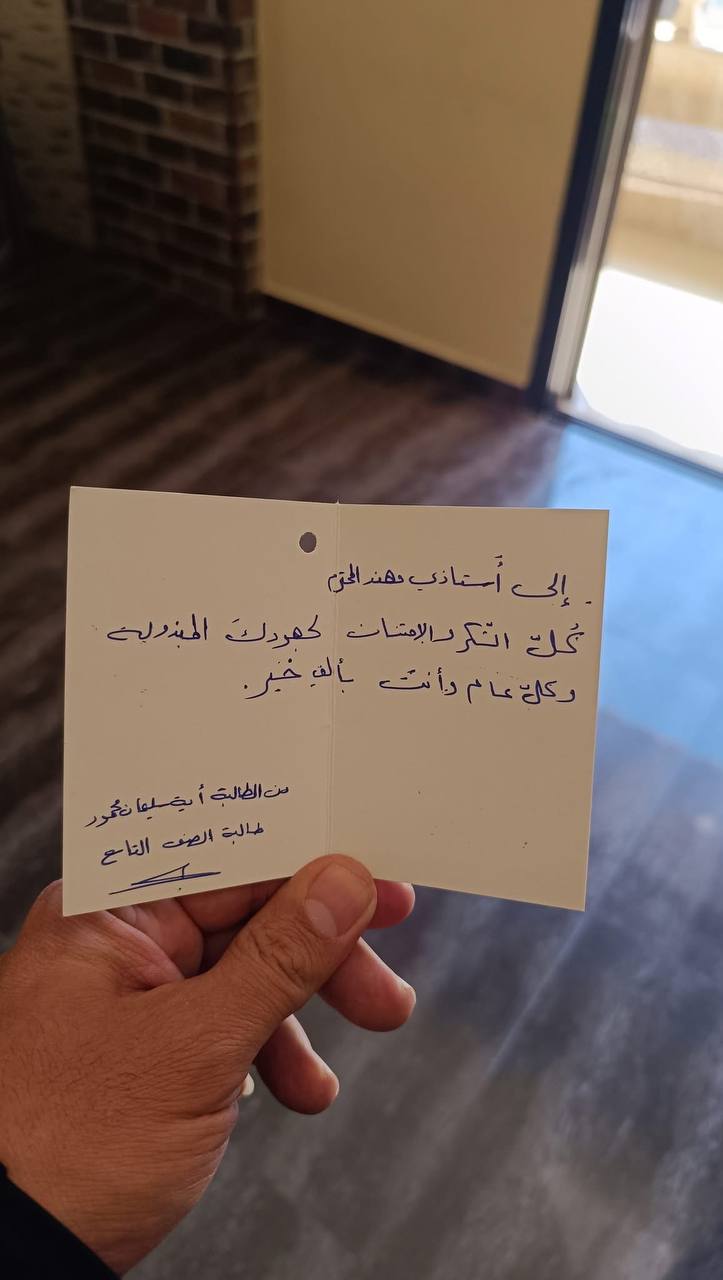  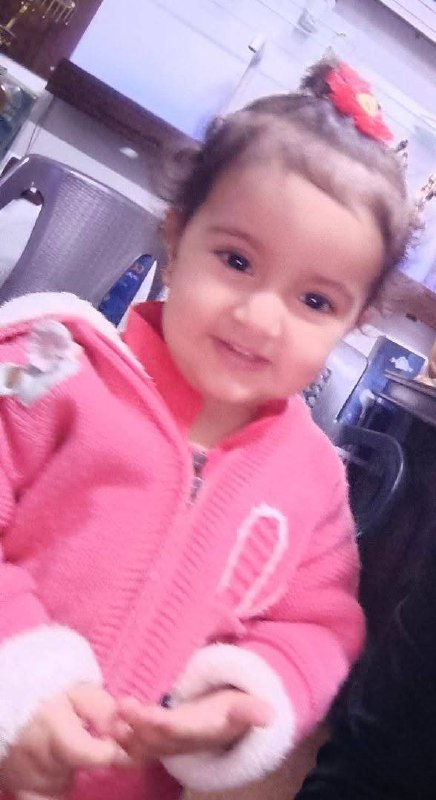 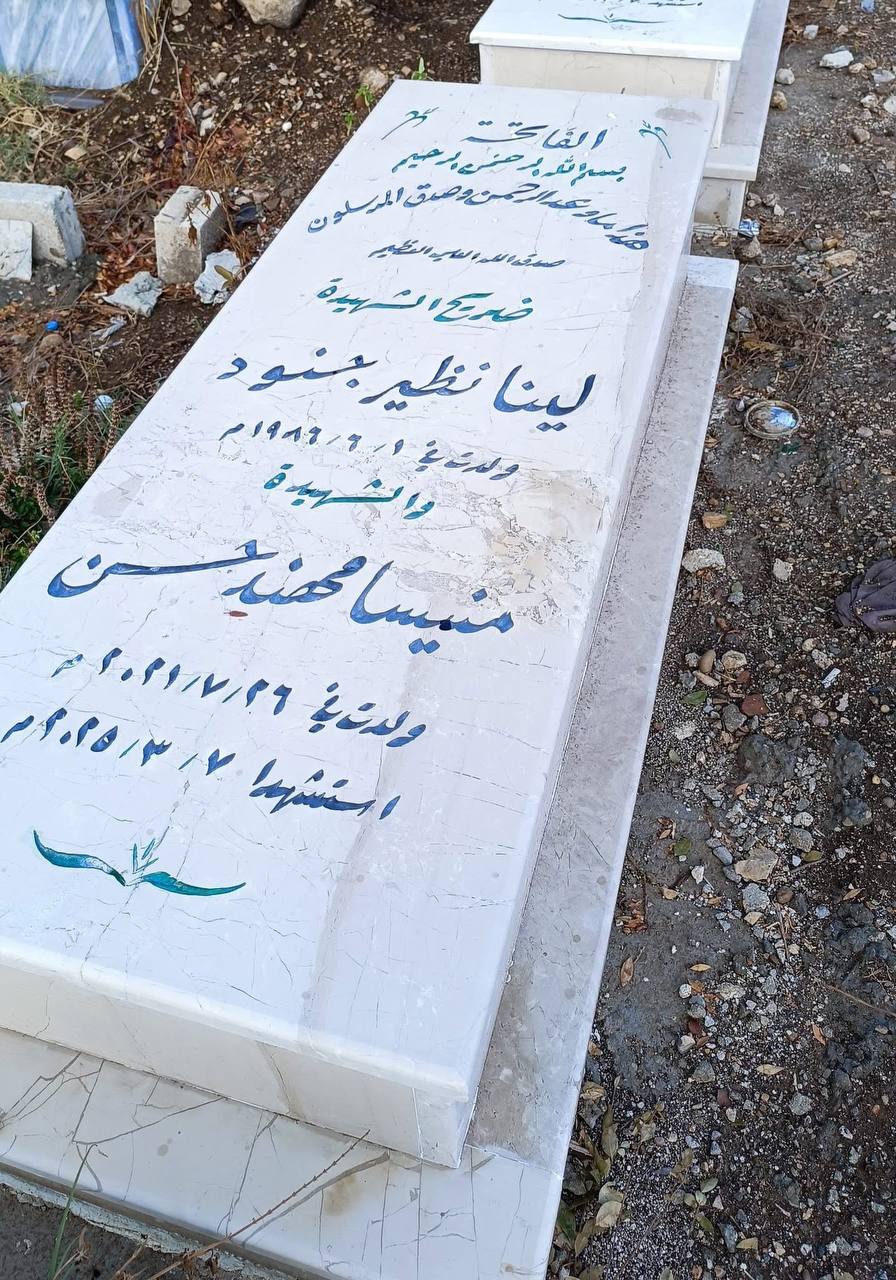 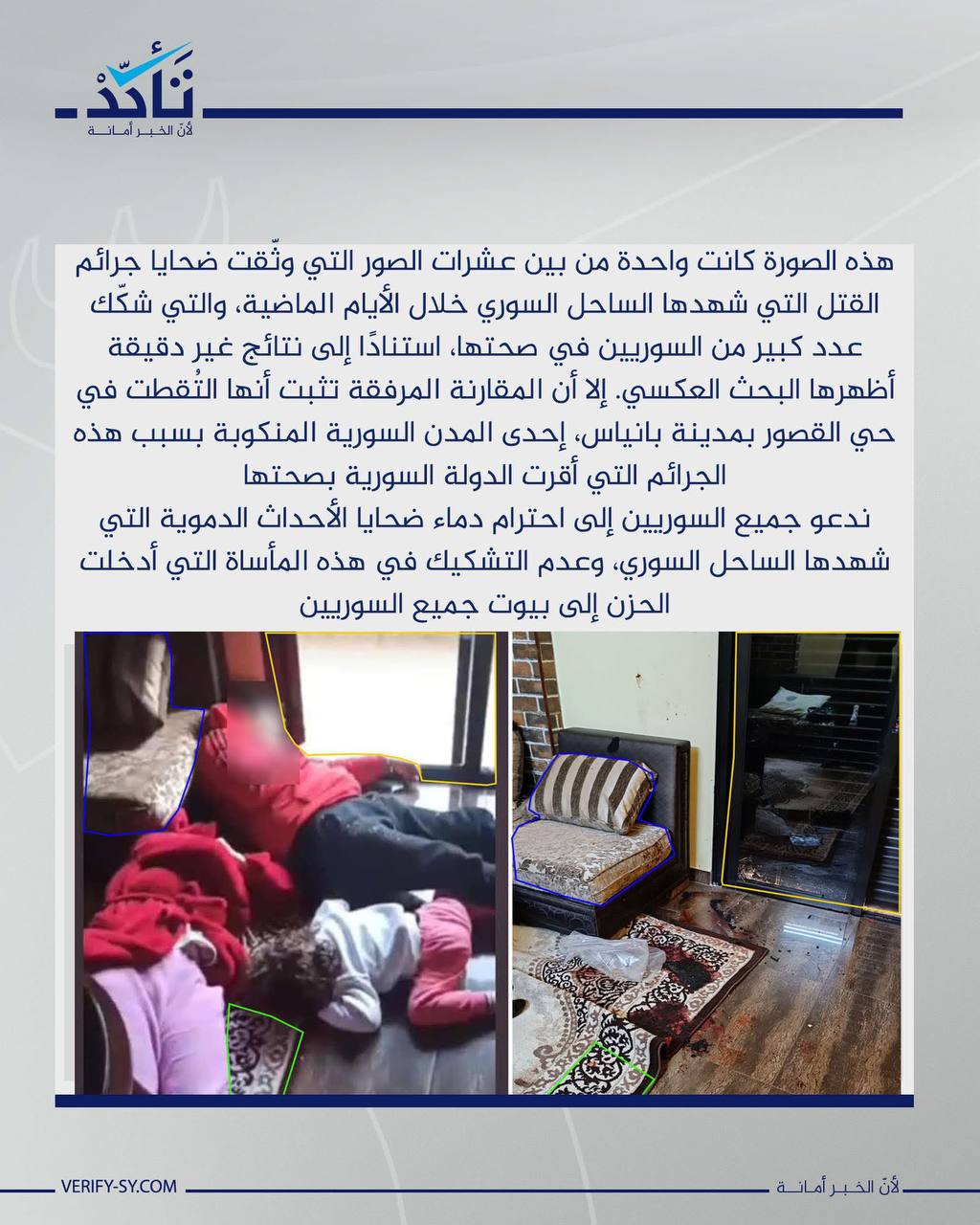 To this day, neither the Alawites of the Syrian coast nor the Druze of #Suwayda have seen anything resembling justice. No one has been held accountable. No one who gave the orders has faced consequences. Instead, the regime's media machine keeps rewriting history, and counting on the world not to notice.
2026-03-16T18:13
Source: Syria Memorial
March 2025
Reuters Special Report | Syrian Coast Massacres: 1,500 Alawites Killed in Three Days — Chain of Command Leads to Damascus
A Reuters investigation has revealed that Syrian forces loyal to the new government — backed by Islamic militias and former HTS fighters — carried out mass killings of more than 1,500 Alawite civilians in Syria's coastal provinces, including Latakia and Tartous, between March 7 and 9. The massacres followed an armed rebellion by former loyalists of ousted President Bashar al-Assad, which — according to authorities — killed more than 200 members of the new security forces. The investigation, based on more than 200 interviews with victims' families, testimonies from field commanders, security officers, former opposition fighters, written documents, victim lists, videos, and confidential correspondence between Defense Ministry officials, traced the chain of command that led to the massacres and linked it directly to senior officials now serving the new government in Damascus. **Context of the Massacres** According to the investigation, the massacres came as retaliation for an uprising led by former officers of the Republican Guard, the Fourth Division, and Air Force Intelligence who rejected the legitimacy of the new regime. As the rebellion spread, orders were issued from senior military leaders — some of whom had recently joined the new government — to crush what they called "fuloul" (remnants of the Assad regime). However, hardline fighters interpreted the word to mean "anyone who is Alawite," especially in villages known for their former loyalty to the regime. **A Horrific Crime in Rasafa** In the town of Rasafa, one of the most horrific crimes was recorded. 25-year-old Suleiman Rashid Saad was brutally killed — the gunmen sliced open his chest, ripped out his heart, and placed it on top of his body. The killers called his father from his mobile phone and mockingly told him: "His body is next to the barbershop… come and get it if you can." His name was number 56 on a list of 60 killed from his village, including children, neighbors, and relatives. **Those Involved** According to Reuters, security and military units participated in carrying out the killings, most notably: • The General Security Service of the new government, a security extension of the former body that administered Idlib province. • Unit 400, a former elite HTS fighting unit. • The Othman Brigade, an armed Islamist faction belonging to the Salafi-jihadist current. • The Sultan Suleiman Shah Division and the Hamza Division, two armed groups formerly backed by Turkey and subject to European sanctions for violations in northern Syria. Despite many of these factions being internationally classified as human rights violators, no sanctions from the United States or the European Union have been imposed on those involved in the recent coastal massacres. **The New Government's Position** Syria's new president, Ahmad al-Sharaa, who took power after the collapse of the Assad regime, condemned the violence in an interview with Reuters, describing it as "a threat to Syria's unity and the path of justice." He affirmed that no one involved would be immune from accountability, even if they were "among those closest to him." "We fought to defend the oppressed, and we will not accept that any blood be shed unjustly, or goes without punishment," al-Sharaa said. Al-Sharaa ordered the formation of a national investigation committee, headed by legal adviser Yasser Farhan, which began hearing testimonies from more than a thousand survivors and victims' families, in addition to reviewing security reports and interrogating dozens detained in connection with the massacres. Farhan said the committee would submit its final report to the president within two weeks, and asked Reuters to delay publishing its findings to preserve "the integrity of the process and responsible truth-telling." **Divergent Responses** While Tartous governor Ahmad al-Shami insisted that "the Alawite sect is not being targeted," he acknowledged what he described as "unacceptable violations" in which at least 350 Alawites were killed in his province alone — a figure the government had not previously disclosed. "The Alawites suffered under Assad just as the rest of Syrians did, and they are not targeted by official decisions," al-Shami said, adding: "We are committed to providing protection for all sects, especially after this chaos." Meanwhile, the European Union offered no explanation for not sanctioning former HTS units, while the U.S. State and Treasury Departments declined to comment on the investigation's findings. **International Warnings and Internal Doubts** Analysts warn that the international community's failure to respond to these massacres risks reproducing cycles of sectarian reprisal in Syria. Syrian activists have also expressed fears that slogans of "justice" and "liberation" are being used as cover for widespread violations, especially given the continuing campaigns of arrests, killings, and sectarian liquidation in some coastal villages to this day.
March 2025
Source: Reuters — Maggie Michael
July 2025
'Alawites, you are pigs': How Damascus-linked forces massacred dozens in the coastal village of Sharifa
Eyewitness investigation documenting the Sharifa village massacre on March 7, 2025. Armed factions affiliated with the Damascus government, joined by armed Sunni civilians from neighboring villages, stormed the Alawite village in Latakia governorate, massacring 30 people — including 3 women and 27 men — and systematically looting and torching homes and shops over three days.
July 2025
Source: The Cradle
2025
Barabshbu and Zoubar massacres: atrocities carried out by Syrian security forces
The Cradle Arabic documents the massacres of Barabshbu and Zoubar, detailing how Syrian security forces carried out systematic killings against Alawite civilians in these villages.
2025
Source: The Cradle Arabic
2025
The Alawite women taken as sex slaves in Syria
The Spectator investigates the abduction and sexual enslavement of Alawite women in Syria, including a harrowing testimony from a survivor who was raped and sold to a commander in Idlib.
2025
Source: The Spectator
2025
Over 3,000 extrajudicial executions reported in Syria since Sharaa rise to power
The Cradle reports that more than 3,000 extrajudicial executions have been documented in Syria since Ahmed al-Sharaa came to power, highlighting the scale of unlawful killings carried out with impunity across the country.
2025
Source: The Cradle
2025
Damascus plans the Mukhtariya massacre: mass executions under the cover of fabricated clashes
The Cradle Arabic reveals how the Mukhtariya massacre was systematically planned, with mass executions carried out against Alawite civilians under the guise of armed clashes that were fabricated to justify the killings.
2025
Source: The Cradle Arabic
November 2025
Syrian killers who treated victims like dogs get away with murder
The Times investigates how perpetrators of massacres against Alawite and minority communities in Syria continue to evade accountability, with killers operating freely despite documented atrocities. The report exposes the impunity surrounding sectarian violence on the Syrian coast.
November 2025
Source: The Times
March 11, 2025
A year after Assad's fall in Syria, Alawite women face kidnappings and rape
AP News documents how Alawite women in Syria continue to face kidnapping and sexual violence by militants and extremists more than a year after the fall of Bashar al-Assad's government. The report details systematic abuses targeting minority communities along the Syrian coast.
March 11, 2025
Source: AP News
March 2025
"All I could think about was death": Syrian Alawite women tell BBC their stories of kidnapping and assault
Syrian Alawite women recount harrowing accounts of abduction and sexual violence at the hands of armed groups following the fall of Assad. The BBC gathered testimonies from survivors describing systematic targeting of Alawite communities.
March 2025
Source: BBC Arabic
August 2025
Violations Against Civilians in Coastal and West-Central Syria (January–March 2025) — Full Report (PDF)
The complete text of the official UN Independent Commission of Inquiry report, containing detailed legal analysis and recommendations.
August 2025
Source: UN Commission of Inquiry (COI)
August 2025
UN Syria Commission Finds March Coastal Violence Was Widespread and Systematic
Expanded report based on over 200 interviews and field visits. Finds evidence of war crimes committed by transitional government forces, documenting approximately 1,400 deaths.
August 2025
Source: UN Commission of Inquiry (COI)
March 2025
Syria: Distressing Scale of Violence in Coastal Areas
UN statement confirming that entire families were killed based on their sectarian identity, based on testimonies describing home raids and victims being asked about their affiliation before being killed.
March 2025
Source: UN Human Rights (OHCHR)
October 2025
"Left to Their Fate": Grave Violations Against Alawites Following the Coastal Massacres
Monitors ongoing violations between March 10 and end of June 2025 across five governorates, including kidnapping, torture, and sexual violence. Criticizes the national committee for ignoring military command responsibility.
October 2025
Source: Syrians for Truth and Justice
June 2025
Syria: Arbitrary and Extrajudicial Killings Target Civilians Ahead of Coastal Violence
Documents summary executions targeting Alawites in Homs and Hama villages since January 2025, weeks before the March massacres, pointing to a systematic pattern predating the major events.
June 2025
Source: Syrians for Truth and Justice
September 23, 2025
"Are You Alawi?" — Identity-Based Killings During Syria's Transition
Joint 51-page report based on over 100 interviews. Documents arbitrary executions, property destruction, and arbitrary detention, proving that crimes occurred as part of a centrally coordinated military operation by the Ministry of Defense.
September 23, 2025
Source: HRW + Syrians for Truth and Justice + Syrian Archive
March 10, 2025
Syria: End Coastal Killing Spree, Protect Civilians
Initial field report documenting summary executions and grave violations against Alawite communities in Latakia, Tartous, and Hama. Reveals that battalions affiliated with the Syrian National Army bear responsibility for most killings.
March 10, 2025
Source: Human Rights Watch
April 2025
Syria: Coastal Massacres of Alawite Civilians Must Be Investigated as War Crimes
Documents the killing of more than 100 people in Baniyas between March 8–9, based on 32 documented cases concluded to be deliberate and sectarian. Armed men were asking victims about their sect before executing them.
April 2025
Source: Amnesty International
March 2025
Syria: Horrific Killings of Civilians on Northwest Coast Must Be Investigated
Initial statement issued immediately after events, calling for civilian protection and cessation of ongoing violations on the Syrian coast.
March 2025
Source: Amnesty International